

Carmine Rimi
14 posts

How To Develop Successful Machine Learning Projects On A Budget – A quick journey through some of the principles for a successful AI getting started project. The article includes an example of how to go from nothing to something – from data pipeline creation to models in production. The primary focus is on a model

AI Tales: Building Machine learning pipeline using Kubeflow and Minio – Understand the Kubeflow value proposition in an entertaining format. The story starts with Joe, the neighbourhood Machine learning enthusiast. Joe reads a few things, becomes an expert, and then the real fun begins. He quickly runs into problems with portability, DevO

Canonical announces full enterprise support for Kubernetes 1.16, starting with the beta release, with support covering the following installation mechanisms – kubeadm, Charmed Kubernetes, and MicroK8s. The beta release of Kubernetes offers users an opportunity to test some of the upcoming features and to validate containerised workloads
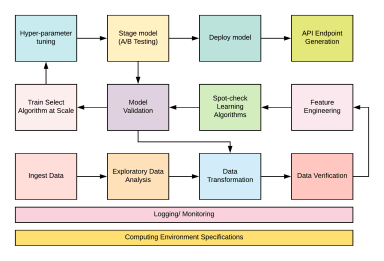
Kubeflow for Poets – This article introduces the core concepts necessary to understand all of the moving pieces in a Kubeflow based machine learning Pipeline. It includes a brief introduction to microservices, Docker, Kubeflow, Kubernetes, virtualisation, Google cloud and more. Read this article for step-by-step low level interaction with

How AI Is Changing The Game For Recruiting – In this use case spotlight, we review how machine learning toolkits like Kubeflow and AI are changing the recruiting industry. Talent acquisition is expensive, and getting it wrong is more expensive. AI can helping improve talent acquisition efficiency and effectiveness. From finding the right

Replicating Particle Collisions at CERN with Kubeflow – this post is interesting for a number of reasons. First, it shows how Kubeflow delivers on the promise of portability and why that matters to CERN. Second, it reiterates that using Kubeflow adds negligible performance overhead as compared to other methods for training. Finally, the p

Kubeflow — a machine learning toolkit for Kubernetes – An introduction to Kubeflow from the perspective of a data scientist. This article quickly runs through some key components – Notebooks, Model Training, Fairing, Hyperparameter Tuning (Katib), Pipelines, Experiments, and Model Serving. If you are looking for a quick overview, give thi

Kubeflow v0.6: support for artifact tracking, data versioning & multi-user – version 0.6 includes several enterprise features to support multiple users and better model training pipelines. For multiple users, Kubeflow v0.6 provides a flexible architecture for user isolation and single sign-on. For data, enhancements have been added to Kub

Kubeflow 0.5 simplifies model development with enhanced UI and Fairing library – The 2019 Q1 release of Kubeflow goes broader and deeper with release 0.5. Give your Jupyter notebooks a boost with the redesigned notebook app. Get nerdy with the new kfctl command line tool. Power to the people – use your favourite python IDE

A portable, multi-cloud install for Knative, using Microk8s.

Kubeflow at OSCON 2019 – Over 10 sessions! Covering security, pipelines, productivity, ML ops and more. Some of the sessions are led by end-users, which means you’ll get the real deal about using Kubeflow in your production solution Kubeflow at KubeCon Europe 2019 in Barcelona – The top Kubeflow events from Kubecon in Barcelona, 2019.
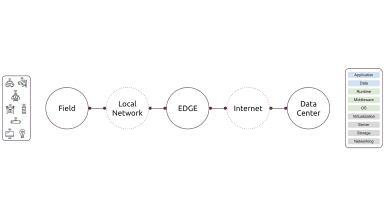
Edge computing continues to gain momentum to help solve unique challenges across telco, media, transportation, logistics, agricultural and other market segments. If you are new to edge computing architectures, of which there are several, the following diagram is a simple abstraction for emerging architectures: In this diagram you can see

This article is the first in a series of machine learning articles focusing on model serving. I assume you’re reading this article because you’re excited about machine learning and quite possibly Kubeflow as well. You might have done some model training and are now trying to understand how to serve those models in production. There

Kubeflow, the Kubernetes native application for AI and Machine Learning, continues to accelerate feature additions and community growth. The community has released two new versions since the last Kubecon – 0.4 in January and 0.5 in April – and is currently working on the 0.6 release, to be released in July. The key features in