
Blog posts tagged "MAAS"
In this blog, you will learn about some of the new features now available in the latest MAAS release.
![High-performance computing (HPC) technologies: what does the future hold? [part 6]](https://ubuntu.com/wp-content/uploads/c0b9/future-of-hpc-blog.png)
his is a very exciting time for HPC, as we are seeing a lot of innovation in the space. Servers are taking on advanced capabilities in terms of compute and networking and we are seeing compatibility increase. Overall cluster deployment and usage is being driven by ease of use.
![Open Source in HPC [part 5]](https://ubuntu.com/wp-content/uploads/3c97/Screenshot-2022-11-28-at-13.38.42.png)
Introduction to open source HPC focused applications and components.

The Ubuntu circle: We are because you are The MAAS 3.3 Beta 1 release is out. You should take a look. Normally, a blog like this would wait for the final release. And that blog will still happen, later, but this feels like a watershed moment: There are some significant new features, including better search

Being the best open-source company in the world means building the best open-source documentation. That’s means giving appropriate respect for ownership and prior art. We crave your feedback about how to best make that happen.
![High-performance computing (HPC) cluster architecture [part 4]](https://ubuntu.com/wp-content/uploads/3e9f/HPC-cluster-architecture.png)
This article describes what HPC clusters are, their various components and their particular purposes. It also covers the different types of HPC clusters.

Developers want Kubernetes infrastructure that is fast, consistent, and without limits! Platform engineering, IT, and DevOps teams are adopting Kubernetes as a Service (KaaS) now more than ever before to streamline efficiency for dev teams and operations. But what happens when the requirement involves deploying clusters directly on top of

Bare metal Kubernetes is a powerful set of technologies that builds on the best ideas behind the public and private cloud, yet abstracts away some toilsome aspects related to virtualisation management and networking. For operators and users, it provides significant benefits, making it easier and faster to ship and maintain complex, distri

2022 is right around the corner, and it’s not just time to prepare for Christmas, play video games, buy presents, or share anti-Christmas memes. It’s time to start making some predictions for bare metal Kubernetes! Take a minute and let’s think about it. Developers have advent of code so they’re busy right now. Sysadmins and
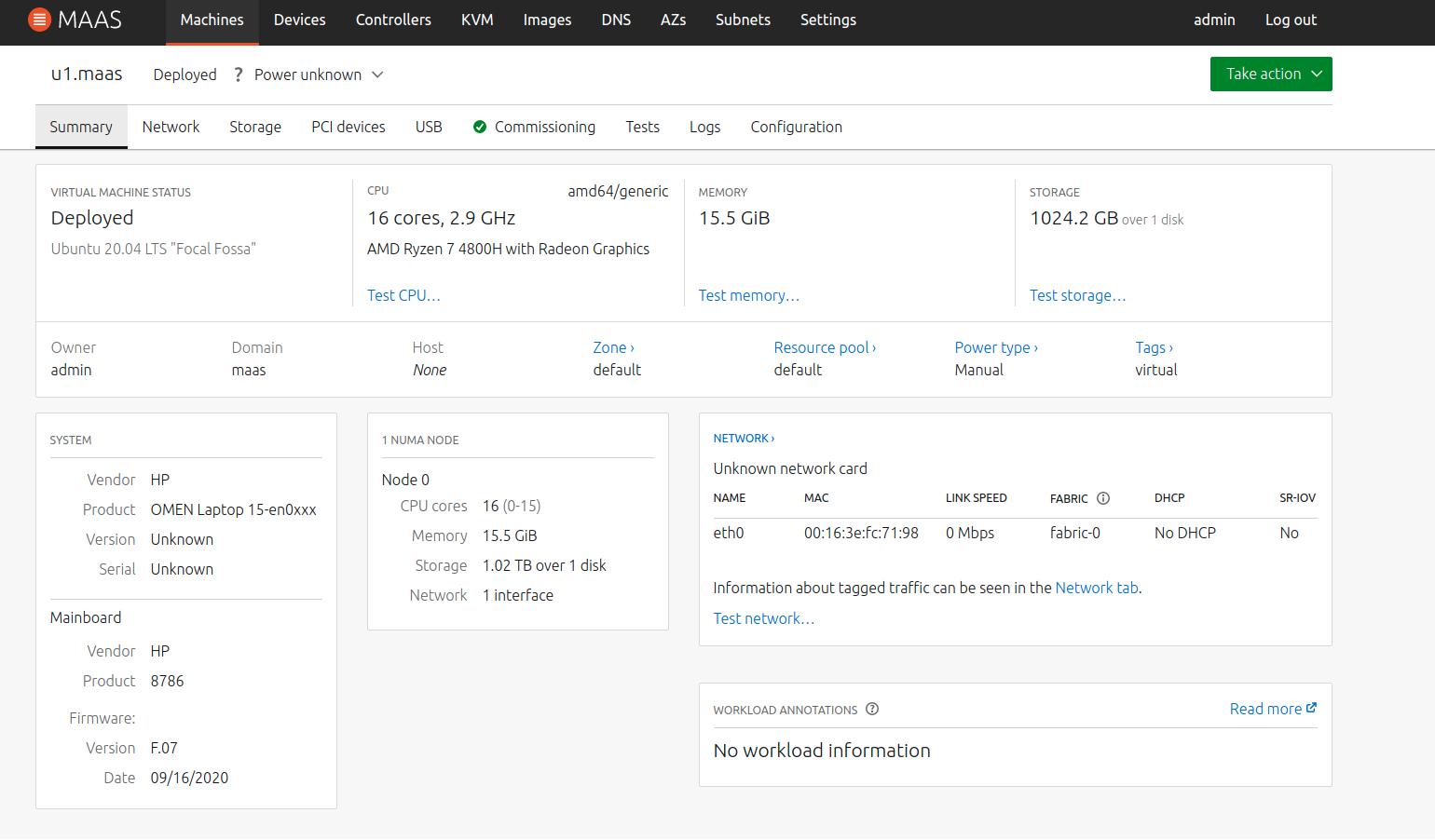
Back a few months ago, we did a feature poll on our MAAS forum, and the most-requested new feature turned out to be “Recommission/rescan a machine after it has been deployed“. With the release of MAAS 3.1, we’ve added that feature, making MAAS an even better choice for linux deployment tools. Here’s a sample of

We are happy to announce that MAAS 3.1 has been released. Bare metal provisioning just got even easier! MAAS 3.1 brings some of the most frequently-requested features into the product. A lot of this is serendipity — or maybe you could say that it’s about like minds tracking the same problem. Either way, we’re doing

Bare metal Kubernetes (K8s) is now easier than ever. Spectro Cloud has recently posted an article about integrating Kubernetes with MAAS (Metal-as-a-Service. In the article, they describe how they have created a provider for the Kubernetes Cluster API for Canonical MAAS (Metal-as-a-Service). This blog describes briefly the benefits of ba

Now that Canonical is prolonging the lifecycle of Ubuntu 14.04 LTS ‘Trusty Tahr’ and 16.04 LTS ‘Xenial Xerus’ to a total of ten years, it’s a good time to reflect on how else Canonical supports these releases for bare metal cloud. Bare metal lifecycle management Whether you’re running a small or a large fleet of

We want to make it possible to deploy MAAS in an existing datacenter, and have it keep track of machines that already have a deployed workload — without disturbing machine or workload. Currently, in order to get a machine into MAAS, with correct hardware information, you have to network boot the machine and let MAAS

With the release of MAAS 3.0, we moved LXD virtual machines out of Beta. Several articles in the MAAS documentation address LXD. Since no document ties all these features together, though, it’s time for a topical blog about LXD. About LXD LXD, pronounced “lex-DEE,” is a container manager, as well as a virtual machine manager.

This blog title should really be, “Why you always, always, always want conflict detection turned on on all the networks MAAS touches,” but that’s really long as a title. But hear me out. As promised, here is another DHCP blog, this time explaining how you can have multiple DHCP servers on the same subnet, serving